March 2026
AFRC showcase: automating audited financial statements
At a Cyberport event with the Accounting and Financial Reporting Council, the team walked through a live case study: turning source documents into an audited financial statement a reviewer can check.

As an incubatee of the Cyberport Incubation Programme, Cannex presented a live case study on a familiar problem: preparing audited financial statements from messy source files.
The demo followed the work in order. Source documents go into one place: company registry filings such as NAR1 and ND2A, board resolutions, trial balances, general ledgers, and the prior-year audited financial statements. The trial balance is mapped to disclosures and schedules using the prior year, so the report stays consistent. The general ledger is scanned for items that need a look, and the statement of cash flows is prepared on the indirect method with a trail back to the numbers. An HKFRS disclosure checklist then marks which footnotes are still open.
The same point sits in the AFRC’s February 2026 publication on AI. The software drafts and cross-checks. It does not replace the reviewer. Client data stays in a private environment, not in a public model. E-Financials is the reporting workflow; CFO Hub is the wider accounting and corporate-services workspace around it.
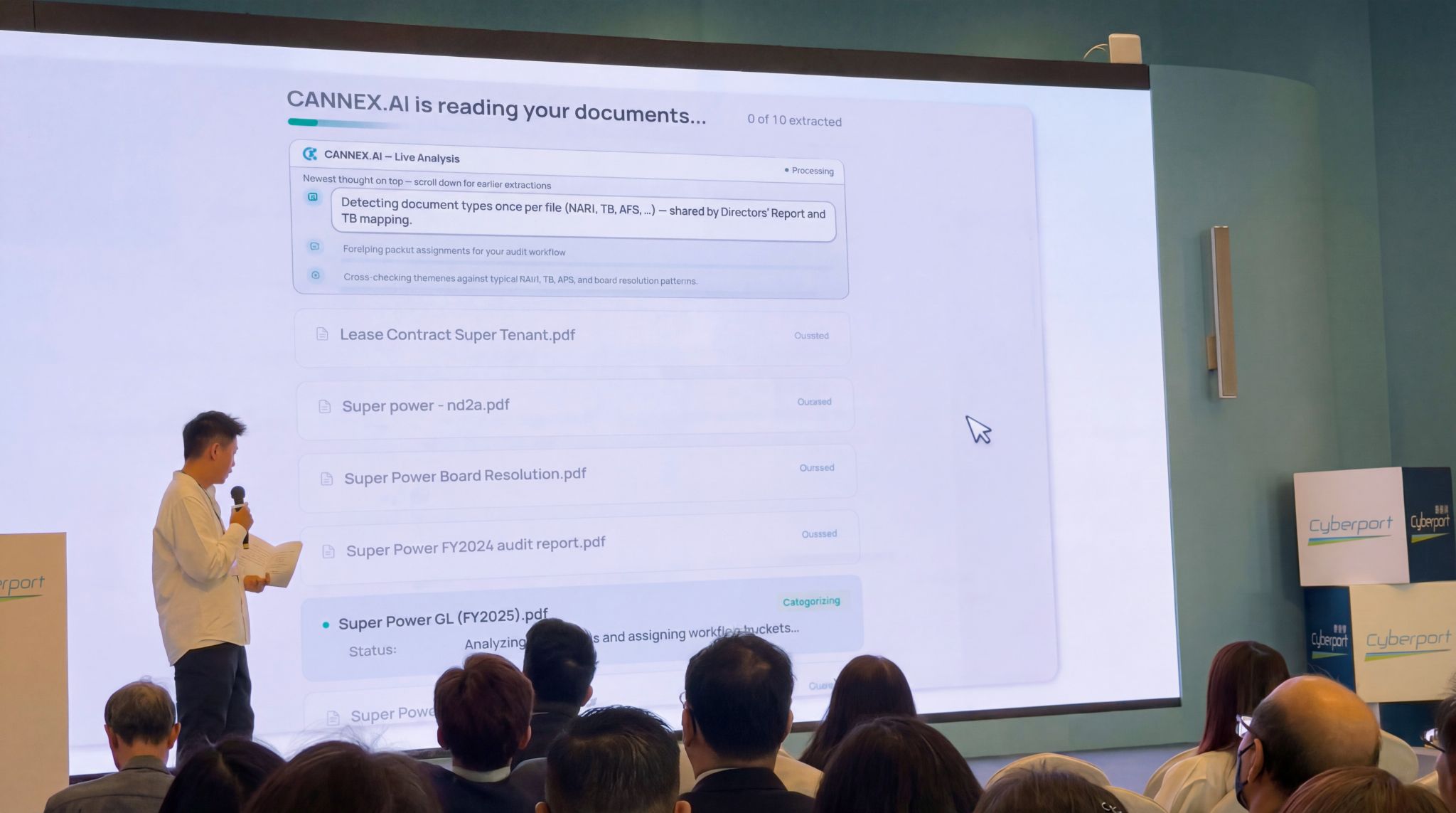
Live demo of Cannex reading NAR1, ND2A, board resolutions, an audit report, and a general ledger
What we showed
- Data hub. Bulk upload, then extraction from NAR1, ND2A, board resolutions, trial balances, general ledgers, and prior-year audited financial statements.
- Trial balance mapping. Prior-year logic carries into this year’s disclosures and schedules.
- Audit-ready checks. General-ledger exceptions, and a statement of cash flows (indirect method) that traces back to the source.
- HKFRS checklist. Footnotes checked against the current disclosure requirements before sign-off.